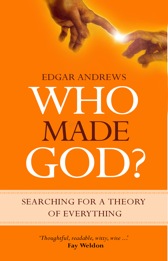
After several weeks in the reading, I finally finished
Who Made God? by Professor Edgar Andrews yesterday.
It's a fair enough question. We live in a universe where every effect has a cause, and we struggle to imagine what an Ultimate Cause might look like. Some people refuse point blank to admit that such a thing is even possible (although the alternative, infinite regression, is even less helpful in the long run). So, who - if anyone - made God?
One of the big problems in today's world is that there is no solid intellectual framework any more. The postmodern philosophy of "each person makes their own truth" leads to a huge void, littered with wishy-washy touchy-feely relativistic notions, none of which ever base their claims on anything more substantial than "what feels right for you". And then on the other hand, you get Dawkins-esque militant atheism, which tries to reduce the entire universe - even non-physical things such as love and hate, and people's sense of the spiritual - to mere chemical interactions. The point of the book
Who Made God? is to show that these worldviews are ultimately hollow, and to demonstrate that belief in the one God of the Bible is in fact a much more intellectually satisfying position, as it explains phenomena which atheism cannot approach, and answers questions which materialism can never hope to deal with.
It must be said: for a book dealing with such complex ideas, it's incredibly readable. Andrews' choice of illustrations and use of humour make his arguments very easy to follow. I would recommend it to anybody, Christian or otherwise.
Among other things, Andrews deals with the origins debate, and the problem of pain, two of the favourite themes of anti-Christian argument, and shows that a consistent Biblical worldview can in fact deal with them. And while I was reading, I realised something:
Many people (e.g.
David Attenborough) argue that because the world is damaged (parasites exist, etc), God cannot have created it as Genesis claims he did - but in making that argument, they miss out the fact that Genesis also says God gave us humans the planet, and we went and broke it. While reading the book and pondering this issue, I came up with this analogy: suppose you go to the Louvre, Paris, to see the Mona Lisa. You get there, and you find a big rip down the middle of the canvas. The curator has pulled the two sides of the rip back together and run some gaffer tape along the back to hold it in place, so you can still get a pretty good impression of what the painting used to be like, but it is still quite clearly torn. Now, you look at the damaged painting, and you say "Wait up...
The Complete History of Painting claims that Da Vinci painted the Mona Lisa on a non-torn canvas, but this canvas definitely *is* torn. Therefore, clearly, Da Vinci never really existed!"
Clever you. The fact that the canvas is torn doesn't disprove
The Complete History of Painting's claim that Da Vinci painted the Mona Lisa, or the fact that the canvas was originally whole. What it proves is that somebody has come along since then, and vandalised the painting.
So it goes with the world around us. Yes, granted, the 'canvas' of life on earth is quite clearly ripped down the middle, and suffering and death are a day-to-day part of existence in the present. But that doesn't mean that it was always like that. A consistent reading of the Bible - as Andrews advocates - perfectly explains the dichotomy between original perfection and present imperfection. And despite the gaffer-taped rip in the picture, many of the painting's intricacies still shine through - from the unparalleled sophistication of the DNA data-processing systems inside our own cells, out to the majestic clockwork of the galaxies in the sky.
For my own part, I have never been able to accept that complexity can arise from chance processes. I have done some computer programming, and I am all too painfully aware that a single misplaced piece of punctuation in your source code can send the whole program up in smoke. Writing even the simplest program takes effort, intelligence, and an understanding of the programming syntax. Sitting down and randomly mashing your fists into a keyboard will never produce working software. Having studied both biology (with an option module in genetics) and computing (the serious one, with binary and stuff, not to be confused with mere ICT) at A-Level, I see a strong analogy between computer codes and the genetic code. Although they are carried on different media and serve different functions, the two systems are essentially variations on the same information-handling principles. And if it's that hard to write even a tiny little game program for Windows, then as a programmer I am absolutely convinced that it must require an unimaginably vast - infinite, even - intelligence to 'program' the genomes of the countless living organisms we see around us. Evolution claims to be driven by mutations - and a mutation is basically a genetic typo. Typos don't write software, they create bugs, and any programmer worth his salt will make sure that he removes any bugs that arise in his work, before shipping the software to his customer. Equally, mutations do not create life. They create cancer, haemophilia and cystic fibrosis, among countless other horrible diseases.
In the age-old 'watchmaker' analogy, lots of people have seen fit to deny the intelligence (or even the existence) of the watchmaker, preferring to believe that the 'watch' (i.e. sophisticated functional systems) of the cosmos somehow 'just happened' on their own, as though a keyboard somewhere randomly mashed some disembodied fists into itself and 'just happened' to write Windows 7, OSX Snow Leopard or Ubuntu 10.10 by sheer fluke, through an impossibly lucky string of random keystrokes.
But I find it infinitely more plausible, and much more satisfying, to give credit where credit is due and to recognise both the intelligence which originally created the painting, back in the days when the canvas was whole, and the forces of arrogance and stupidity which have subsequently torn it - and my response: to worship the watchmaker.
Don't believe me?
Go and read the book.
- The Colclough