Finished a couple of things today.
One was writing the first draft of Megastropulodon! Series 1 Episode 5, Eggs of Devastation. At the final count, the draft comes to 29 pages, 65 scenes, 6400-and-something words. Obviously, it's far from being ready to shoot, and it'll take a lot more drafts before it's good to go, but I've got it past the first hurdle: the bones of the story are out there on the paper. (Word-processor, actually, but never mind.)
So now, I can get started on Episode 6. And once that's done, it'll be back to Episode 1 to start on Second Drafts. And so on, and so forth...
My other achievement today has been to finish reading this paper on 'the Distant Starlight Problem' - an objection sometimes raised against Biblical creationism. In short, the author does some clever stuff with Relativity theory, and eliminates the problem. But it's taken me nearly three days to read, because it's one of the two most confusing things I've ever tried reading, and I had to keep stopping for long breaks to prevent my brain melting.
I should point out that it's not really Dr. Lisle's fault that it's confusing. The confusing-ness is down to the Relativity-Theory-based nature of the article, so it can largely be blamed on Einstein and/or on the fabric of the universe itself.
The other most confusing thing I've ever tried reading was Donna Haraway's 'Cyborg Manifesto'. If you've never read it, don't bother. If you'd never even heard of it until you read this paragraph, be very grateful. It got inflicted on me during the second year of my media degree, but I never finished reading it, because it was making no sense at all, and I was getting the melting-brain feeling without any worthwhile payback. It was a prime example of mere human philosophy (possibly drug-induced, judging by the psychedelic pseudo-logic involved) setting up frameworks and theories that had no practical bearing at all on the real world, despite an impressive-sounding claim to be able to explain basically everything.
The big difference between that, and Dr. Lisle's paper, was that Lisle is talking about the real world and his arguments are built on established scientific principles (mostly Einstein). So despite the sensation of molten neurons starting to trickle out of my earholes as I read, I felt that I was getting something worthwhile out of the exercise. Namely, an answer to the 'distant starlight problem'. I don't think I could really summarise what he said without confusing you, but if it's an issue you've ever worried about then I'd recommend taking a look at the paper - just make sure you pack your head in ice first to stop it going up in smoke.
Be ye warned: the rest of this post consists of a couple of thematic left turns...
Yesterday, my best amigo Tim posted the 86th and final episode of Sidewards, his bizarre but rather enjoyable spin-off from my main webcomic, Cylinder and Miserable. The ending caught me by surprise, as I didn't know how many strips he'd actually written. But it's been great fun reading the comic. I mean, it's about squabbling, half-psychotic bacon sandwiches committing industrial sabotage... what more do you want?
Speaking of webcomics, have you been reading Fort Paradox, and if so what's your reaction? Has your grey matter survived so far?
And finally, on another not-really-related note, a quick update for the RH crowd: I went through the various segments of the video the other day (I'm editing it in 4 different parts to stop Vegas crashing) and added up the runtimes - and the total came out at 33 minutes 19 seconds, which is within 4 minutes of the 30-minute target runtime. So the good news is, the video might actually be closer to completion than I'd realised! The next step will be to watch through the segments, check for boring bits, and trim accordingly. Once that's done, I should hopefully have got the runtime down to 30 minutes by natural wastage, and then it'll be time for my Workflow Pudding - designing and making the nice shiny chapter-heading graphics and things. If you thought the 2008 video was good, you ain't seen nothing yet!
- The Colclough
Showing posts with label Worldview. Show all posts
Showing posts with label Worldview. Show all posts
Thursday, 11 November 2010

Monday, 1 November 2010
The Watchmaker
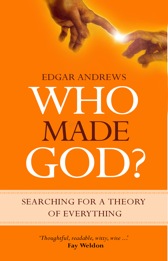
After several weeks in the reading, I finally finished Who Made God? by Professor Edgar Andrews yesterday.

It's a fair enough question. We live in a universe where every effect has a cause, and we struggle to imagine what an Ultimate Cause might look like. Some people refuse point blank to admit that such a thing is even possible (although the alternative, infinite regression, is even less helpful in the long run). So, who - if anyone - made God?
One of the big problems in today's world is that there is no solid intellectual framework any more. The postmodern philosophy of "each person makes their own truth" leads to a huge void, littered with wishy-washy touchy-feely relativistic notions, none of which ever base their claims on anything more substantial than "what feels right for you". And then on the other hand, you get Dawkins-esque militant atheism, which tries to reduce the entire universe - even non-physical things such as love and hate, and people's sense of the spiritual - to mere chemical interactions. The point of the book Who Made God? is to show that these worldviews are ultimately hollow, and to demonstrate that belief in the one God of the Bible is in fact a much more intellectually satisfying position, as it explains phenomena which atheism cannot approach, and answers questions which materialism can never hope to deal with.
It must be said: for a book dealing with such complex ideas, it's incredibly readable. Andrews' choice of illustrations and use of humour make his arguments very easy to follow. I would recommend it to anybody, Christian or otherwise.
Among other things, Andrews deals with the origins debate, and the problem of pain, two of the favourite themes of anti-Christian argument, and shows that a consistent Biblical worldview can in fact deal with them. And while I was reading, I realised something:
Many people (e.g. David Attenborough) argue that because the world is damaged (parasites exist, etc), God cannot have created it as Genesis claims he did - but in making that argument, they miss out the fact that Genesis also says God gave us humans the planet, and we went and broke it. While reading the book and pondering this issue, I came up with this analogy: suppose you go to the Louvre, Paris, to see the Mona Lisa. You get there, and you find a big rip down the middle of the canvas. The curator has pulled the two sides of the rip back together and run some gaffer tape along the back to hold it in place, so you can still get a pretty good impression of what the painting used to be like, but it is still quite clearly torn. Now, you look at the damaged painting, and you say "Wait up... The Complete History of Painting claims that Da Vinci painted the Mona Lisa on a non-torn canvas, but this canvas definitely *is* torn. Therefore, clearly, Da Vinci never really existed!"
Clever you. The fact that the canvas is torn doesn't disprove The Complete History of Painting's claim that Da Vinci painted the Mona Lisa, or the fact that the canvas was originally whole. What it proves is that somebody has come along since then, and vandalised the painting.
So it goes with the world around us. Yes, granted, the 'canvas' of life on earth is quite clearly ripped down the middle, and suffering and death are a day-to-day part of existence in the present. But that doesn't mean that it was always like that. A consistent reading of the Bible - as Andrews advocates - perfectly explains the dichotomy between original perfection and present imperfection. And despite the gaffer-taped rip in the picture, many of the painting's intricacies still shine through - from the unparalleled sophistication of the DNA data-processing systems inside our own cells, out to the majestic clockwork of the galaxies in the sky.
For my own part, I have never been able to accept that complexity can arise from chance processes. I have done some computer programming, and I am all too painfully aware that a single misplaced piece of punctuation in your source code can send the whole program up in smoke. Writing even the simplest program takes effort, intelligence, and an understanding of the programming syntax. Sitting down and randomly mashing your fists into a keyboard will never produce working software. Having studied both biology (with an option module in genetics) and computing (the serious one, with binary and stuff, not to be confused with mere ICT) at A-Level, I see a strong analogy between computer codes and the genetic code. Although they are carried on different media and serve different functions, the two systems are essentially variations on the same information-handling principles. And if it's that hard to write even a tiny little game program for Windows, then as a programmer I am absolutely convinced that it must require an unimaginably vast - infinite, even - intelligence to 'program' the genomes of the countless living organisms we see around us. Evolution claims to be driven by mutations - and a mutation is basically a genetic typo. Typos don't write software, they create bugs, and any programmer worth his salt will make sure that he removes any bugs that arise in his work, before shipping the software to his customer. Equally, mutations do not create life. They create cancer, haemophilia and cystic fibrosis, among countless other horrible diseases.
In the age-old 'watchmaker' analogy, lots of people have seen fit to deny the intelligence (or even the existence) of the watchmaker, preferring to believe that the 'watch' (i.e. sophisticated functional systems) of the cosmos somehow 'just happened' on their own, as though a keyboard somewhere randomly mashed some disembodied fists into itself and 'just happened' to write Windows 7, OSX Snow Leopard or Ubuntu 10.10 by sheer fluke, through an impossibly lucky string of random keystrokes.
But I find it infinitely more plausible, and much more satisfying, to give credit where credit is due and to recognise both the intelligence which originally created the painting, back in the days when the canvas was whole, and the forces of arrogance and stupidity which have subsequently torn it - and my response: to worship the watchmaker.
Don't believe me? Go and read the book.
- The Colclough
It's a fair enough question. We live in a universe where every effect has a cause, and we struggle to imagine what an Ultimate Cause might look like. Some people refuse point blank to admit that such a thing is even possible (although the alternative, infinite regression, is even less helpful in the long run). So, who - if anyone - made God?
One of the big problems in today's world is that there is no solid intellectual framework any more. The postmodern philosophy of "each person makes their own truth" leads to a huge void, littered with wishy-washy touchy-feely relativistic notions, none of which ever base their claims on anything more substantial than "what feels right for you". And then on the other hand, you get Dawkins-esque militant atheism, which tries to reduce the entire universe - even non-physical things such as love and hate, and people's sense of the spiritual - to mere chemical interactions. The point of the book Who Made God? is to show that these worldviews are ultimately hollow, and to demonstrate that belief in the one God of the Bible is in fact a much more intellectually satisfying position, as it explains phenomena which atheism cannot approach, and answers questions which materialism can never hope to deal with.
It must be said: for a book dealing with such complex ideas, it's incredibly readable. Andrews' choice of illustrations and use of humour make his arguments very easy to follow. I would recommend it to anybody, Christian or otherwise.
Among other things, Andrews deals with the origins debate, and the problem of pain, two of the favourite themes of anti-Christian argument, and shows that a consistent Biblical worldview can in fact deal with them. And while I was reading, I realised something:
Many people (e.g. David Attenborough) argue that because the world is damaged (parasites exist, etc), God cannot have created it as Genesis claims he did - but in making that argument, they miss out the fact that Genesis also says God gave us humans the planet, and we went and broke it. While reading the book and pondering this issue, I came up with this analogy: suppose you go to the Louvre, Paris, to see the Mona Lisa. You get there, and you find a big rip down the middle of the canvas. The curator has pulled the two sides of the rip back together and run some gaffer tape along the back to hold it in place, so you can still get a pretty good impression of what the painting used to be like, but it is still quite clearly torn. Now, you look at the damaged painting, and you say "Wait up... The Complete History of Painting claims that Da Vinci painted the Mona Lisa on a non-torn canvas, but this canvas definitely *is* torn. Therefore, clearly, Da Vinci never really existed!"
Clever you. The fact that the canvas is torn doesn't disprove The Complete History of Painting's claim that Da Vinci painted the Mona Lisa, or the fact that the canvas was originally whole. What it proves is that somebody has come along since then, and vandalised the painting.
So it goes with the world around us. Yes, granted, the 'canvas' of life on earth is quite clearly ripped down the middle, and suffering and death are a day-to-day part of existence in the present. But that doesn't mean that it was always like that. A consistent reading of the Bible - as Andrews advocates - perfectly explains the dichotomy between original perfection and present imperfection. And despite the gaffer-taped rip in the picture, many of the painting's intricacies still shine through - from the unparalleled sophistication of the DNA data-processing systems inside our own cells, out to the majestic clockwork of the galaxies in the sky.
For my own part, I have never been able to accept that complexity can arise from chance processes. I have done some computer programming, and I am all too painfully aware that a single misplaced piece of punctuation in your source code can send the whole program up in smoke. Writing even the simplest program takes effort, intelligence, and an understanding of the programming syntax. Sitting down and randomly mashing your fists into a keyboard will never produce working software. Having studied both biology (with an option module in genetics) and computing (the serious one, with binary and stuff, not to be confused with mere ICT) at A-Level, I see a strong analogy between computer codes and the genetic code. Although they are carried on different media and serve different functions, the two systems are essentially variations on the same information-handling principles. And if it's that hard to write even a tiny little game program for Windows, then as a programmer I am absolutely convinced that it must require an unimaginably vast - infinite, even - intelligence to 'program' the genomes of the countless living organisms we see around us. Evolution claims to be driven by mutations - and a mutation is basically a genetic typo. Typos don't write software, they create bugs, and any programmer worth his salt will make sure that he removes any bugs that arise in his work, before shipping the software to his customer. Equally, mutations do not create life. They create cancer, haemophilia and cystic fibrosis, among countless other horrible diseases.
In the age-old 'watchmaker' analogy, lots of people have seen fit to deny the intelligence (or even the existence) of the watchmaker, preferring to believe that the 'watch' (i.e. sophisticated functional systems) of the cosmos somehow 'just happened' on their own, as though a keyboard somewhere randomly mashed some disembodied fists into itself and 'just happened' to write Windows 7, OSX Snow Leopard or Ubuntu 10.10 by sheer fluke, through an impossibly lucky string of random keystrokes.
But I find it infinitely more plausible, and much more satisfying, to give credit where credit is due and to recognise both the intelligence which originally created the painting, back in the days when the canvas was whole, and the forces of arrogance and stupidity which have subsequently torn it - and my response: to worship the watchmaker.
Don't believe me? Go and read the book.
- The Colclough
Wednesday, 1 September 2010
Vision from the Edge of the World
I only left the group around the barbecues to get away from the smoke. I'd been queueing for ages, right next to one of the disposable charcoal trays, and getting gassed. I wandered off down the beach, not really planning to go very far, but the tide was out - a long, long way out - and I just kept plodding. Don't really know why.
Quarter of a mile later, I finally came to a standstill a few yards into the water. Nothing left, just the ripples on the water, and the sky coloured by the sunset behind me. No sounds worth speaking of.
And then I realised what I was looking at. You might not think a simple, flat line could be so profound, but I realised that when you live inland, you never really see the horizon. It's always hidden behind buildings, fences, cars, wheelie bins, blah de blah de blah. So much clutter obscuring the view. But out here in the edge of the tide, there was nothing left to get in the way, and the crystal-sharp boundary between the end of the world and the start of the sky stretched on and on and on all around.
And then came one of those odd little moments, when some little snippet of fiction takes on a whole new layer of meaning which the original writers probably never intended.
I've never played Portal, but I've heard the end credits song Still Alive a few times, and as I stood in the shallows at Littlehampton the line came to mind, "Now these points of data make a beautiful line". So? Life, as perceived from this side of eternity, often seems to consist of a long and convoluted string of random events - points of data, one could call them. Meanwhile, in another train of thought, it is an important component of Christian belief that God has a plan for the whole of history - past, present and future, and that when we reach heaven (i.e. upon arrival on the other side of death) our own place in this plan will become clear, if we hadn't realised it already.
And then, the two ideas came together, and I realised that this little snippet of fiction is actually a near-perfect parallel to what I expected death to be like. All the clutter will fall away from view, the horizon will be cleared, and my points of data - currently so strange and incomprehensible - will form a beautiful line, just like the song says, and I will be able to understand what I was actually doing on this planet for all of these years.
This new clarity came a few days after I had sat on a pile of wood chippings back at the campsite late in the evening, while everyone else was in the barn, talking, drinking, playing games. I had sat on the top of the pile, stared up at the majesty of the clear sky, and asked what I was here for. Then, on the thin end of the tide at Littlehampton, I was shown something amounting to an answer: "It's not time for you to know yet. But there will be light and clarity in the end."
In a way, I'm rather looking forward to being dead. Not to dying, mind you - I've never coped well with pain, and I'm happy to keep putting off the process of death for the time being. But as for what comes beyond? In another snippet of fiction, in The Return of the King, Gandalf describes death to Pippin during the siege of Minas Tirith, and says something about "white shores, and a swift sunrise". And there I had it, painted for me in the water and the air: a foretaste of the light, beauty and clarity that will follow hard on the heels of my last mortal breath. And there, enthroned above the circle of the earth, I will be able to look on the face of God. Not because I am good enough for him - far from it, so very, very far from it - but because he has chosen to pay my debt for me and forgive me everything. I will be able to stand before his radiant purity, clothed in his grace, and belong.
And then, I doubt I will ever want to move again.
I can't show you a photo of myself standing in the waves that night, because there was nobody else there to hold the camera. And even if there had been, the picture wouldn't fill the purpose anyway, because my outside shell has never even begun to approach the profundity and beauty to which my soul aspires. For once in my largely vision-orientated life, I find words are the better medium.
I came within inches of death later that night. But it was not my time, and I was left to live again, to find more points of data to add to the eventual line.
I've felt a little hollow in the two days since coming home from Root Hill, and now I've realised what's wrong with me: what I'm missing is the sense of engagement with reality which I felt during those nine days in the field on the other side of Surrey. I'm back at home, back within earshot of two constantly-grumbling smaller siblings, back in the banal rut of day-to-day existence, back with the nagging feeling that I ought to be doing something that I'm currently not doing, but not having a clue what that something might be.
But I intend to remember that horizon, and to find out what that something is that I need to do.
Don't expect everything I post on here to be all profound and angsty. It almost definitely won't be. I often resort to flippancy, mainly as a survival mechanism, and a lot of that will probably emerge here.
But there you have it. That evening in the fringes of the sea functioned, ironically, as a sort of new dawn in terms of my perception of the world, and now I need to go away and make something of the new day.
I shall start by throwing away some of the clutter from my cupboards, my desk and - I hope - my brain.
Watch this space.
- The Colclough
Quarter of a mile later, I finally came to a standstill a few yards into the water. Nothing left, just the ripples on the water, and the sky coloured by the sunset behind me. No sounds worth speaking of.
And then I realised what I was looking at. You might not think a simple, flat line could be so profound, but I realised that when you live inland, you never really see the horizon. It's always hidden behind buildings, fences, cars, wheelie bins, blah de blah de blah. So much clutter obscuring the view. But out here in the edge of the tide, there was nothing left to get in the way, and the crystal-sharp boundary between the end of the world and the start of the sky stretched on and on and on all around.
And then came one of those odd little moments, when some little snippet of fiction takes on a whole new layer of meaning which the original writers probably never intended.
I've never played Portal, but I've heard the end credits song Still Alive a few times, and as I stood in the shallows at Littlehampton the line came to mind, "Now these points of data make a beautiful line". So? Life, as perceived from this side of eternity, often seems to consist of a long and convoluted string of random events - points of data, one could call them. Meanwhile, in another train of thought, it is an important component of Christian belief that God has a plan for the whole of history - past, present and future, and that when we reach heaven (i.e. upon arrival on the other side of death) our own place in this plan will become clear, if we hadn't realised it already.
And then, the two ideas came together, and I realised that this little snippet of fiction is actually a near-perfect parallel to what I expected death to be like. All the clutter will fall away from view, the horizon will be cleared, and my points of data - currently so strange and incomprehensible - will form a beautiful line, just like the song says, and I will be able to understand what I was actually doing on this planet for all of these years.
This new clarity came a few days after I had sat on a pile of wood chippings back at the campsite late in the evening, while everyone else was in the barn, talking, drinking, playing games. I had sat on the top of the pile, stared up at the majesty of the clear sky, and asked what I was here for. Then, on the thin end of the tide at Littlehampton, I was shown something amounting to an answer: "It's not time for you to know yet. But there will be light and clarity in the end."
In a way, I'm rather looking forward to being dead. Not to dying, mind you - I've never coped well with pain, and I'm happy to keep putting off the process of death for the time being. But as for what comes beyond? In another snippet of fiction, in The Return of the King, Gandalf describes death to Pippin during the siege of Minas Tirith, and says something about "white shores, and a swift sunrise". And there I had it, painted for me in the water and the air: a foretaste of the light, beauty and clarity that will follow hard on the heels of my last mortal breath. And there, enthroned above the circle of the earth, I will be able to look on the face of God. Not because I am good enough for him - far from it, so very, very far from it - but because he has chosen to pay my debt for me and forgive me everything. I will be able to stand before his radiant purity, clothed in his grace, and belong.
And then, I doubt I will ever want to move again.
I can't show you a photo of myself standing in the waves that night, because there was nobody else there to hold the camera. And even if there had been, the picture wouldn't fill the purpose anyway, because my outside shell has never even begun to approach the profundity and beauty to which my soul aspires. For once in my largely vision-orientated life, I find words are the better medium.
I came within inches of death later that night. But it was not my time, and I was left to live again, to find more points of data to add to the eventual line.
I've felt a little hollow in the two days since coming home from Root Hill, and now I've realised what's wrong with me: what I'm missing is the sense of engagement with reality which I felt during those nine days in the field on the other side of Surrey. I'm back at home, back within earshot of two constantly-grumbling smaller siblings, back in the banal rut of day-to-day existence, back with the nagging feeling that I ought to be doing something that I'm currently not doing, but not having a clue what that something might be.
But I intend to remember that horizon, and to find out what that something is that I need to do.
Don't expect everything I post on here to be all profound and angsty. It almost definitely won't be. I often resort to flippancy, mainly as a survival mechanism, and a lot of that will probably emerge here.
But there you have it. That evening in the fringes of the sea functioned, ironically, as a sort of new dawn in terms of my perception of the world, and now I need to go away and make something of the new day.
I shall start by throwing away some of the clutter from my cupboards, my desk and - I hope - my brain.
Watch this space.
- The Colclough
Subscribe to:
Posts (Atom)